

You probably know that long term cost of dental implants are more than dentures or bridges. The price tag might seem hard to justify when cheaper options exist. But when you look at what happens over 10, 20, or 30 years, the numbers tell a different story.
Dental implants typically cost between $3,000 and $6,000 per tooth upfront, but they can last 25 years or longer with proper care, while bridges need replacing every 7 to 10 years and dentures every 5 to 8 years, making implants often less expensive over time.
The money you save comes from avoiding repeated replacements, protecting your other teeth from damage, and preventing bone loss that leads to more dental problems.
Understanding why dental implants justify their higher price helps you make the right choice for your health and wallet. You’ll learn exactly what you’re paying for, how the costs compare over decades, and whether this investment makes sense for your situation.
Key Takeaways
- Dental implants cost more initially but often cost less than bridges or dentures over 20 to 30 years because they don’t need frequent replacements
- Implants protect your jawbone and surrounding teeth from damage, preventing expensive dental problems that other options can’t stop
- Payment plans and insurance coverage can make the upfront cost manageable while you gain the long-term value of permanent tooth replacement
What Makes Dental Implants Expensive Upfront?
The high initial cost of dental implants comes from premium materials, specialized training, advanced technology, and sometimes extra procedures to prepare your jaw. Each component and step in the process adds to the total investment.
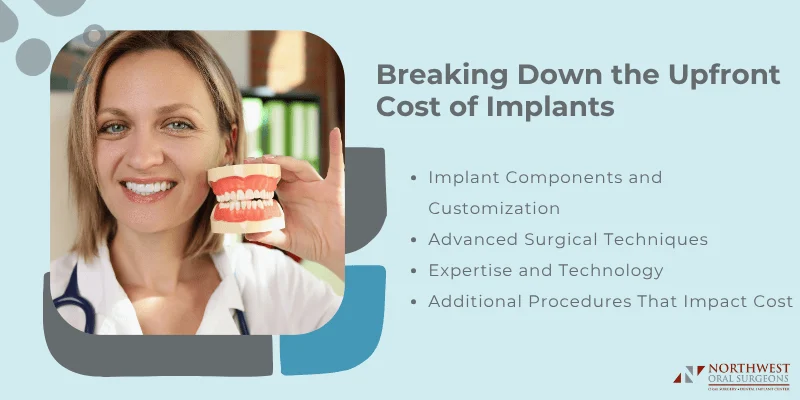
Implant Components and Customization
Your dental implant consists of three separate parts that work together. The implant post, made from medical-grade titanium, serves as an artificial tooth root and costs between $1,000 and $2,000.
This post gets surgically placed into your jawbone where it fuses with the bone over time.
The abutment connects the post to your final tooth. This small connector piece typically costs $300 to $500 and transfers chewing forces from the crown down into your jawbone.
The custom-made crown forms the visible part of your tooth. A dental lab creates this crown to match your other teeth in color, shape, and size. Custom-made crowns cost between $800 and $1,500 because they’re individually crafted for your mouth.
Advanced Surgical Techniques
Surgical placement requires precision that takes years to master. The cost of a single dental implant includes multiple stages over several months.
Your dentist first places the implant post during a surgical procedure. You then wait 3-6 months for the bone to fuse with the post. After healing, your dentist attaches the abutment in a second procedure. Finally, they place your custom crown.
Each stage requires careful monitoring and adjustments. Your dentist checks the healing process and ensures the implant integrates properly with your bone.
Expertise and Technology
The fee for implant dentistry reflects specialized training beyond dental school. An oral surgeon or implant specialist has advanced knowledge of jaw anatomy that helps avoid complications like nerve damage or sinus perforation.
Advanced imaging technology adds $100 to $500 to your total cost. 3D scans map your jawbone structure and show exactly where nerves and blood vessels sit. This technology allows for safer, more precise placement of your tooth implant.
Digital impression systems and computer-guided surgery further increase accuracy. These tools help your dentist plan the exact angle and depth for your implant.
Additional Procedures That Impact Cost
Many patients need bone grafting before getting an implant. When your jawbone lacks sufficient density or volume, a graft strengthens the area. Bone grafts cost between $400 and $3,000 depending on the extent needed.
A sinus lift becomes necessary for upper back teeth when the sinus cavity sits too close to the jaw. This specialized procedure adds $1,500 to $2,500 to your total investment.
If you need a damaged tooth removed first, the extraction adds another $150 to $700. Some people also need treatment for gum disease before implant placement can begin safely.
Comparing Costs: Dental Implants vs Other Tooth Replacement Options
When you’re weighing tooth replacement options, the price tags can look very different at first glance. A single tooth implant might cost $3,000 to $6,000, while dentures start around $1,500 to $3,000 for a full set.
Initial Investment Versus Ongoing Expenses
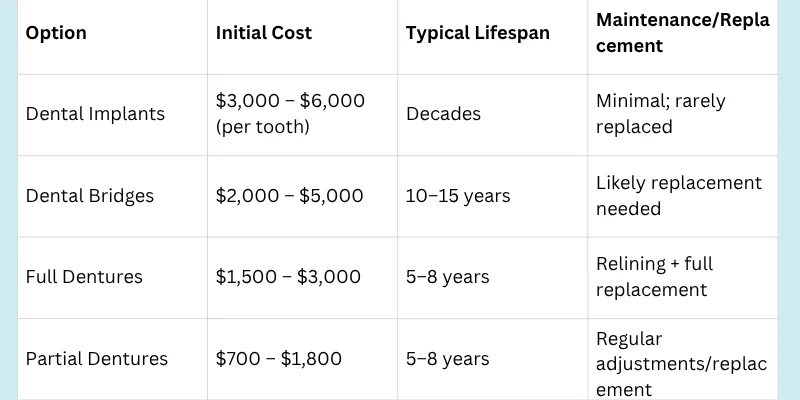
The upfront cost of tooth implants is higher than other tooth replacement options. You’ll pay between $3,000 and $6,000 for a single tooth implant, including the post, abutment, and crown.
Traditional dentures cost less initially at $1,500 to $3,000 per set. Dental bridges fall in the middle at $2,000 to $5,000. Partial dentures are the most budget-friendly option at $700 to $1,800.
But these lower prices don’t tell the whole story. Dentures need relining every few years and complete replacement every 5 to 8 years. Bridges typically last 10 to 15 years before needing replacement.
Implants can last decades with proper care. You won’t face the same cycle of repairs and replacements that come with other options.
How Dentures and Dental Bridges Add Up Over Time
Your dentures will need regular maintenance that adds up fast. Denture adhesives cost $5 to $15 monthly, totaling $600 to $1,800 over ten years. Professional adjustments run $100 to $300 each visit.
Complete denture replacement every 5 to 8 years means you could spend $3,000 to $6,000 multiple times throughout your life. If you get dentures at age 50, you might replace them four or five times.
Dental bridges require replacing the crowns on supporting teeth when they wear out. The healthy teeth used as anchors may need root canals or other treatments over time. These complications can add $1,000 to $3,000 per tooth to your total costs.
The Impact of Tooth Loss on Adjacent Teeth
When you choose dental bridges to replace a missing tooth, your dentist must grind down the neighboring healthy teeth. This process weakens them permanently and makes them more prone to decay and damage.
Those supporting teeth now carry extra chewing force. About 30% of bridge-supporting teeth need root canal treatment within 10 years due to this added stress.
Dentures create different problems for your remaining natural teeth. The clasps on partial dentures put pressure on adjacent teeth, which can loosen them over time. Bone loss from missing tooth roots also affects nearby teeth, causing them to shift or become unstable.
A single tooth implant stands independently without touching neighboring teeth. This preserves your natural tooth structure and prevents the domino effect of additional tooth loss.
Replacing a Single Tooth vs Full Restoration
The number of implants you need dramatically changes the cost comparison. One missing tooth requires just one implant post with a crown on top.
Multiple missing teeth offer different solutions. You can use two implants to support a three or four tooth bridge for around $8,500. This costs less than placing an individual implant for each missing tooth.
Full arch restoration with All-on-4 uses only four strategically placed implants per arch. The cost ranges from $15,000 to $30,000 per arch. Traditional implant dentures using six to eight implants per arch cost more upfront but provide extra stability.
Compare this to traditional full dentures at $1,500 to $3,000 initially. Over 20 years, you’ll replace those dentures three to four times, spending $6,000 to $12,000 total, plus adhesives and adjustments.
How Dental Implants Save Money in the Long Run
The long-term benefits of dental implants add up to significant savings compared to other tooth replacement options. While you pay more at the start, you avoid the ongoing costs that come with bridges and dentures over the years.
Longevity and Durability
Dental implants typically last 25 years or more with proper care. Many last a lifetime. This durability means you pay once instead of replacing your tooth restoration every few years.
Compare this to a dental bridge that needs replacement every 7 to 10 years. If you get a bridge at age 40, you might need to replace it four or five times by age 80. Each replacement costs $2,000 to $5,000. That adds up to $8,000 to $25,000 over your lifetime.
Dentures need even more frequent updates. They require replacement every 5 to 8 years as they wear down and your jaw changes shape. The crown on an implant might need replacement after 10 to 15 years, but the implant post itself stays in place. This makes dental implants a cost-effective solution when you look at total costs over decades.
Reduced Maintenance and Fewer Repairs
You brush and floss implants just like natural teeth. You don’t need special cleaning products, adhesives, or soaking solutions.
Denture wearers spend about $400 yearly on adhesives alone. Over 20 years, that’s $8,000 just on glue. You also need special cleaning tablets, brushes, and regular adjustments to maintain proper fit.
Your regular dental checkups cover implants without extra appointments or specialized follow-up care. The cost of dental implants includes no hidden maintenance expenses.
While you still need professional cleanings every six months, these visits cost the same whether you have implants or natural teeth.
Avoiding Repeated Dental Treatments
Implants prevent problems that require expensive treatments later. They stop your other teeth from shifting into the gap left by a missing tooth. This shifting can create bite problems that need orthodontic work.
Traditional bridges require grinding down healthy teeth on both sides of the gap. These supporting teeth often need root canals or crowns within 10 years. Each of these procedures costs $1,000 to $3,000.
Implants also prevent bone loss in your jaw. Without a tooth root, your jawbone shrinks over time. This bone loss can affect neighboring teeth and make them loose. A customized treatment plan with implants preserves your bone and protects surrounding teeth from future damage.
While implant failure happens in about 5% of cases, the success rate of 95% means most people avoid these repeat costs entirely.
Oral Health and Quality of Life Benefits
Dental implants deliver health advantages that extend far beyond replacing missing teeth. They preserve bone structure, protect surrounding teeth, and restore full chewing function in ways other tooth replacement options simply cannot match.
Preserving Jawbone and Preventing Bone Loss
Your jawbone needs stimulation to maintain its density and volume. When you lose a tooth, the bone underneath begins to shrink because it no longer receives pressure from chewing.
Dental implants stop this bone loss through osseointegration, where the titanium post fuses directly with your jawbone. This bone integration creates a stable foundation that mimics a natural tooth root.
Every time you chew, the implant transfers force into the bone tissue. This stimulation signals your body to maintain jawbone health instead of allowing it to deteriorate.
Without this stimulation, you can lose 25% of bone width in the first year after tooth loss. The bone continues to shrink over time, which changes your facial structure and can create a sunken appearance. Implants prevent this progressive deterioration and maintain your natural face shape.
Protecting Oral Health and Adjacent Teeth
Traditional bridges require grinding down healthy teeth on both sides of the gap. This compromises teeth that have no decay or damage.
Implants stand independently without touching neighboring teeth. Your healthy teeth remain completely untouched and unaltered.
This conservative approach protects your long-term oral health. Teeth that get filed down for bridges become more vulnerable to decay and may eventually need root canals or extraction.
Studies show bridges last an average of 6.8 years before patients lose another tooth, creating a domino effect of tooth loss.
Implants also make oral hygiene easier. You brush and floss around them just like natural teeth, without special cleaning requirements or adhesives.
Chewing Power and Daily Comfort
Dental implants restore chewing efficiency to levels close to natural teeth. You can eat tough foods like steak, crunchy vegetables, nuts, and apples without worry.
Dentures only provide about 25% of natural chewing power. Many denture wearers avoid healthy foods because they’re too difficult to chew.
This affects your nutrition and overall health. With implants, you maintain a complete diet without restrictions.
Implants feel stable and secure because they’re anchored in bone. There’s no slipping, clicking, or movement when you talk or eat. You don’t need to use messy adhesives or remove them at night.
This daily comfort translates into confidence. You can speak clearly, laugh freely, and smile without self-consciousness about gaps or loose appliances.
Managing Costs: Insurance, Payment Plans, and Affordable Options
Most dental practices offer multiple ways to manage the cost of dental implants, from traditional insurance benefits to monthly payment plans that let you spread expenses over several years.
Understanding your coverage options and alternative financing paths can make implants more accessible than you might expect.
Dental Insurance and Coverage
Traditional dental insurance plans may cover the crown even if they don’t pay for the implant post itself. Some insurance providers pay a percentage of the total cost if an injury caused your tooth loss rather than decay.
Your plan might categorize implants as “major” procedures and reimburse up to 50 percent of the allowed amount. If your current plan doesn’t cover implants, ask if you can receive an allowance equal to what a bridge or denture would cost.
Newer insurance providers increasingly recognize implants as standard care rather than cosmetic work. Check your annual maximum and waiting periods before scheduling treatment, since many plans cap payouts at $1,500 to $2,000 per year.
Financing and Payment Plans
Medical and dental credit plans stretch payments over 12 to 60 months, making a $4,000 implant feel more like manageable monthly bills. Many dental offices also offer in-house payment plans that split costs between the implant placement and crown installation stages.
Third-party lenders provide personal loans specifically for dental work, often with promotional zero-interest periods if you pay within 12 or 18 months. You can also use HSA or FSA funds to cover implants, which reduces your taxable income.
Most practices don’t require the full cost upfront. Combining insurance coverage, a payment plan, and HSA dollars can make the total out-of-pocket expense much smaller than the sticker price suggests.
Dental Discount Plans and Alternatives
Dental discount plans work differently from insurance—you pay an annual fee (usually $100 to $200) and receive 10 to 60 percent off procedures at participating dentists. These plans have no waiting periods or annual maximums.
Dental schools offer another route to reduce costs. Residents place implants under expert supervision at rates 30 to 50 percent lower than private practices. You’ll spend more time in the chair, but the quality remains high.
If you need multiple implants, ask about staged treatment. Placing the post now and adding the crown next year spreads expenses across two benefit years, effectively doubling your insurance coverage.
Frequently Asked Questions
Dental implants involve multiple cost factors and maintenance considerations that differ significantly from other tooth replacement options.
Understanding the specific expenses, lifespan expectations, and long-term health impacts helps you make an informed decision about your dental care investment.
What factors contribute to the higher initial cost of dental implants?
The price of dental implants reflects several complex components working together. You’re paying for a titanium post that gets surgically placed into your jawbone, an abutment that connects the parts, and a custom-made crown that matches your natural teeth.
Your dentist needs specialized training to perform implant procedures. This expertise takes years to develop and requires ongoing education to stay current with techniques.
Advanced technology also adds to the cost. Most implant procedures use 3D imaging to plan exact placement. This equipment is expensive to purchase and maintain.
The materials themselves cost more than alternatives. Titanium is biocompatible and fuses with your bone, but it’s not cheap. The crown is custom-crafted in a dental lab to match your other teeth perfectly.
How can dental implants be a cost-effective choice in the long term?
Bridges typically need replacement every 7 to 10 years. If you replace a bridge three times over 30 years at $4,000 each time, you’ll spend $12,000 or more on the same space.
Dentures require even more frequent attention. They need replacement every 5 to 8 years, and your jawbone changes shape over time, requiring adjustments and relining between replacements.
A single implant might cost $4,500 upfront. But with proper care, it can last 25 years or longer. Many implants last a lifetime, meaning you pay once instead of repeatedly over the years.
What maintenance costs should be considered when comparing implants with other dental procedures?
Dentures require adhesives that cost around $8 per tube and last about two weeks. Over 20 years, you’ll spend over $8,000 just on adhesive products. You’ll also need special cleaning solutions and professional adjustments.
Bridges create cleaning challenges that require special flossers. Food gets trapped more easily under bridges, which can lead to more dental problems and extra visits to address issues with supporting teeth.
Implants get brushed and flossed like your natural teeth. You don’t need special products or complicated cleaning routines. Your regular six-month dental checkups cover your implants the same way they cover your natural teeth.
Are there any long-term health benefits of choosing dental implants over dentures?
Implants are the only tooth replacement option that preserves jawbone health. The titanium post replaces your tooth root and keeps your jawbone active through chewing pressure.
Dentures and bridges sit on top of your gums. They do nothing to prevent bone loss. Over time, your jawbone shrinks, which changes the shape of your face and can make you look older.
Implants stand alone and don’t affect your other teeth. Traditional bridges require grinding down two healthy teeth on either side of the gap. This makes those supporting teeth more vulnerable to decay and future problems.
What is the average lifespan of a dental implant, and how does it compare to other dental restoration options?
Dental implants can last 20 years or more with proper care, and many last a lifetime. The crown on top might need replacement after 10 to 15 years, but the implant post itself typically stays in place permanently.
Bridges last 7 to 10 years before needing complete replacement. You’ll likely need three or four bridges over 30 years in the same location.
Dentures need replacement every 5 to 8 years. As your jawbone changes shape, dentures stop fitting properly even sooner. This means you’ll go through multiple sets throughout your life.
How might dental implants ultimately lead to savings on dental care?
Implants prevent the domino effect of tooth loss. When you lose a tooth, your other teeth start shifting to fill the gap. This creates bite problems and makes cleaning harder, which can lead to more tooth loss down the road.
The two teeth supporting a traditional bridge often develop problems within 10 years. You might need root canals or crowns on those supporting teeth, adding thousands more to your total cost.
Implants help keep your remaining teeth in their proper position by filling the gap. This means fewer orthodontic issues and less chance of losing additional teeth over time.