


If you had a tooth pulled years ago and never replaced it, you might think it’s too late for a dental implant. Maybe you’ve been living with a gap in your smile or struggling with dentures.
The good news is that time doesn’t automatically disqualify you from getting an implant. Yes, you can get dental implants years after tooth extraction, even if it’s been a decade or more since you lost your tooth.
While your jawbone does change over time after losing a tooth, modern dental techniques like bone grafting can rebuild the support you need. The condition of your jawbone and overall oral health will determine the exact steps your dentist needs to take.
The dental implants after old extraction might take a bit longer than if you’d gotten an implant right away. Your dentist will evaluate your specific situation and create a treatment plan that works for you.
Key Takeaways
- You can get dental implants years or even decades after tooth extraction with proper evaluation and treatment
- Bone grafting can rebuild lost jawbone to provide the foundation needed for successful implant placement
- The implant process after years of tooth loss may take longer but offers permanent tooth replacement with natural function
Is It Possible to Get Dental Implants Years After Tooth Extraction?
You can absolutely get dental implants even if your tooth extraction happened years ago. Modern dental implant technology has made it possible to place implants successfully in patients who have been missing teeth for extended periods, though you may need additional procedures to prepare your jawbone.
Modern Dental Implant Options for Long-Term Tooth Loss
Today’s dental implant technology offers you several solutions even after years of tooth loss. The implant post itself is made from titanium or zirconia, materials that bond naturally with your jawbone through a process called osseointegration.
If you’ve waited years after extraction, your dentist can use advanced imaging like 3D CT scans to assess your bone quality. Bone grafting procedures have become highly predictable, allowing dentists to rebuild lost bone structure before placing your tooth implant.
Some modern techniques even allow for same-day tooth replacement in certain cases. Your dentist might use shorter implants or angled placement methods if you have limited bone height.
These innovations mean delayed implant placement is more accessible than ever before.
Want to learn more about long-term tooth loss dental implant options? Contact our team in Schererville or Munster, IN to discuss your dental implant options and see if you’re a candidate today.
Eligibility Factors for Implant Placement Years Later
Your eligibility for an implant after extraction depends on several key factors. Bone density and volume are the most critical considerations since your jawbone naturally shrinks when a tooth is missing.
Your dentist will evaluate:
- Remaining bone height and width at the extraction site
- Overall oral health and gum condition
- Medical conditions like diabetes or osteoporosis
- Smoking habits and lifestyle factors
- Adjacent teeth stability
Most patients can receive dental implants after old extraction with proper preparation. If bone loss has occurred, you’ll likely need bone grafting first.
This adds several months to your treatment timeline but ensures long-term success. Your general health matters too.
Uncontrolled diabetes or active gum disease must be addressed before implant placement.
How Delayed Implants Compare to Immediate and Early Placement
Immediate implant placement happens right after tooth extraction during the same appointment. Early implant placement occurs within 4-8 weeks after extraction.
Delayed implant placement takes place months or years later. Each timing option has distinct advantages.
Immediate implants preserve bone and reduce treatment time, but they’re only suitable when there’s no infection present. Early placement allows some initial healing while still maintaining bone structure.
Your delayed implant approach allows complete healing and infection resolution. While you may face more bone loss, you gain time to prepare financially and mentally for treatment.
The main tradeoff is that delayed implants often require bone grafting as a separate procedure. This extends your overall treatment timeline by 3-6 months compared to immediate or early implant placement.
What Happens in Your Mouth After Tooth Extraction?
When you have a tooth removed, your mouth goes through several changes that can affect your oral health. The jawbone begins to break down without tooth roots to support it, and nearby teeth may start to shift into the empty space.
Bone Loss and Bone Resorption Over Time
Your jawbone needs stimulation from tooth roots to stay healthy and strong. When a tooth is removed, that stimulation stops.
The bone that once supported your tooth begins to break down through a process called bone resorption. This happens because your body sees the bone as no longer necessary.
The jawbone requires stimulation from tooth roots to maintain its density. Studies reveal that you can lose up to 25% of your jawbone width in the first year after tooth extraction.
The bone loss continues over time, though it slows down after the first year. This ongoing process can make it harder to get dental implants later if you wait too long.
How a Missing Tooth Affects Jawbone Health
The deterioration of your jawbone after tooth loss goes beyond just the extraction site. Your facial structure can actually change as the bone shrinks away.
You might notice a sunken appearance around the area where your tooth was removed. Your face may look older or more hollow in that region.
The bone loss can affect how dentures or other dental appliances fit in your mouth. Your jawbone density impacts more than just appearance.
When a tooth is removed, bone resorption can lead to changes in facial structure. The stronger and denser your jawbone stays, the better foundation you have for future dental work.
Shifting Teeth and Misalignment Risks
Your teeth rely on each other for support and proper positioning. When you lose a tooth, the neighboring teeth start to move into the empty space.
Common shifting problems include:
- Adjacent teeth tilting toward the gap
- Teeth drifting forward or backward
- Opposing teeth moving up or down into the space
- Changes to your bite pattern
This movement happens gradually over months and years. Without the support of the extracted tooth, neighboring teeth may gradually move into the space, leading to misalignment issues.
The shifting can make it harder to chew food properly and may cause jaw pain or discomfort.
Oral Health Concerns After Tooth Removal
A missing tooth creates challenges for keeping your mouth healthy. Food particles and bacteria can collect in the gap, making it harder to clean your teeth properly.
You face a higher risk of gum disease around the empty socket. The shifted teeth create new spaces where plaque can build up.
Your bite changes may put extra pressure on certain teeth, leading to wear and tear. Chewing becomes more difficult when you’re missing a tooth.
You might favor one side of your mouth, which can strain your jaw joint. Understanding tooth extraction aftercare helps you prevent complications, but replacing the missing tooth addresses long-term oral health needs.
Have questions about jawbone changes or replacing missing teeth? Contact Northwest Oral Surgeons to discuss your options and plan the best long‑term solution for your oral health.
Bone Grafting and Rebuilding Support for Dental Implants
When a tooth has been missing for years, the jawbone naturally shrinks because it no longer gets stimulation from the tooth root. Bone grafting procedures can rebuild jawbone tissue to create a strong foundation for dental implants, even after significant bone loss has occurred.
Who Needs Bone Grafting Before Implants
You might need a bone graft if you’ve been missing a tooth for an extended period. The jawbone begins to deteriorate shortly after tooth loss and continues shrinking over time.
Gum disease and tooth extractions are common reasons for needing bone grafting before implant placement. Your dental specialist will take X-rays or CT scans to measure bone density and volume in your jaw.
If there isn’t enough healthy bone to support an implant, grafting becomes necessary. People who have worn dentures for many years often experience significant bone loss.
The longer you wait after losing a tooth, the more bone deterioration typically occurs. This makes bone grafting essential for creating adequate support.
Bone Graft Types and the Procedure Explained
Several types of bone grafts are available depending on your specific needs. The graft material can come from your own body, donated human tissue, animal sources, or synthetic materials.
The procedure involves placing bone graft material into areas where bone has been lost. Your dentist makes a small incision in your gum tissue and adds the graft material to rebuild the jawbone.
The bone graft needs at least three months to heal, though larger grafts may require nine to 12 months. After surgery, you’ll experience normal side effects like tenderness and minor swelling for about a week.
Small bone fragments that look like grains of sand may fall out during the first few days, which is completely normal.
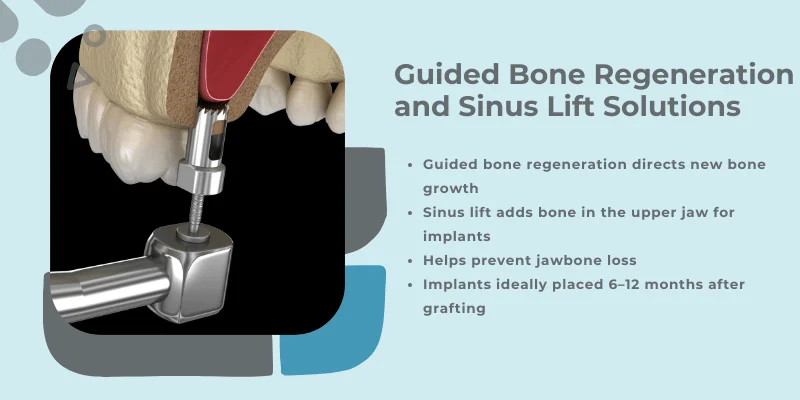
Guided Bone Regeneration and Sinus Lift Solutions
Guided bone regeneration uses a special membrane placed over the bone graft to direct new bone growth in specific areas. This technique works well when you need to build up bone around where the implant will go.
A sinus lift is a specialized bone grafting procedure for your upper jaw. When you’ve lost teeth in the back of your upper jaw, the sinus cavity can drop down into the space where bone used to be.
The sinus lift raises the sinus membrane and adds bone graft material underneath to create enough height for implant placement. Both procedures help prevent bone loss and maintain jawbone health over time.
Study highlights that once healed, it’s best to get your dental implant within six to 12 months to prevent the grafted bone from shrinking again.
Dental Implant Surgery Process After Years of Tooth Loss
The implant surgery process involves several stages that work together to create a stable and lasting tooth replacement. Each step builds on the previous one to give you the best chance at implant success.
Initial Consultation and Oral Health Assessment
Your journey starts with a detailed examination of your mouth and jaw. Many dental offices offer a free consultation where the dentist takes X-rays and CT scans to check your bone density and overall oral health.
This step helps determine if you need any extra treatments before implant placement. The dentist will look at how much bone loss has occurred since your tooth extraction.
If you’ve been missing a tooth for years, your jawbone may have gotten thinner or weaker. The assessment also includes checking your gums for disease and reviewing your medical history to make sure you’re healthy enough for implant surgery.
Based on these findings, your dentist creates a treatment plan. This plan might include bone grafting if your jaw needs more support.
The dentist will explain the timeline and what to expect at each stage.
Implant Placement and Osseointegration
During implant placement, the dentist makes a small cut in your gum to expose the jawbone. They drill a precise hole and insert a titanium post into your jaw.
This post acts as the new tooth root. The most important phase after surgery is osseointegration.
This is when your jawbone grows around the titanium post and fuses with it. The process usually takes 3 to 6 months but can vary based on your bone quality and healing ability.
During osseointegration, you’ll need to follow care instructions carefully. Avoid hard foods and maintain good oral hygiene.
Your dentist will schedule check-ups to monitor how well the bone is bonding with the implant.
Attaching the Crown for Tooth Replacement
Once osseointegration is complete, you return for the final step. The dentist attaches a small connector piece called an abutment to the implant post.
This piece sticks out above your gum line and holds the crown in place. Your dentist takes impressions of your teeth to create a custom crown that matches your natural teeth in color and shape.
The crown is then secured to the abutment, completing your tooth replacement. The entire process from start to finish typically takes 6 to 9 months when starting years after extraction.
Modern techniques have improved the implant success rate to over 95% when proper care is taken during healing.
Benefits of Getting Dental Implants Years After Extraction
Dental implants offer valuable advantages even when you’ve waited years to replace a missing tooth. They provide lasting solutions that improve both your appearance and oral health.
For example, a 6‑month follow‑up study of 150 implant patients found significant increases in overall satisfaction and oral health‑related quality of life after implant placement, including improvements in esthetics, comfort, and reduced psychological discomfort, all markers tied to confidence and well‑being.
Restoring Your Smile and Confidence

Getting a dental implant years after tooth loss can transform how you look and feel about yourself. The implant works like a natural tooth, filling the gap in your smile with a restoration that matches your other teeth in color and shape.
You won’t need to worry about hiding your smile in photos or social situations anymore. Dental implants look natural and blend seamlessly with your existing teeth.
Unlike removable options, dental implants stay firmly in place. You can eat, speak, and laugh without concern that your replacement tooth will shift or fall out.
This stability gives you peace of mind in daily activities. The psychological benefits are just as important as the physical ones.
When you restore your smile with an implant, you often feel more comfortable interacting with others. You may notice improvements in your professional and personal relationships.
Long-Term Oral Health Improvements
Dental implants do more than fill empty spaces. They actively protect your jawbone and prevent problems that develop when teeth stay missing for extended periods.
Your jawbone needs stimulation from tooth roots to maintain its density and shape. When a tooth is gone for years, the bone begins to shrink through a process called resorption.
Dental implants prevent further bone loss by mimicking natural tooth roots and providing the stimulation your jaw needs. Your gum health also benefits from implant placement.
The implant helps maintain proper gum contours and reduces pockets where bacteria can collect. This makes it easier to keep your mouth clean and healthy.
Neighboring teeth won’t shift into the empty space when you get an implant. This maintains your proper bite alignment and prevents the crooked teeth that often result from long-term tooth loss.
Advantages Over Dentures and Bridges
Dental implants offer clear benefits compared to dentures and bridges. They don’t require altering your healthy teeth, which is necessary when placing a traditional bridge.
Implants are more stable than dentures because they anchor directly into your jawbone. You won’t deal with slipping, clicking sounds, or the need for adhesives.
This means you can eat all your favorite foods without restrictions. Maintenance is simpler with implants.
You brush and floss them just like natural teeth, while dentures require removal for cleaning and special soaking solutions. Bridges create hard-to-clean areas that can trap food and lead to decay.
The lifespan of dental implants is impressive. With proper care, they can last 20 years or longer.
Dentures typically need replacement every 5-7 years, and bridges last about 10-15 years before requiring replacement.
Ready to restore your smile with long‑lasting dental implants? Contact Northwest Oral Surgeons in Schererville or Munster, IN to explore your options and schedule a consultation today.
Frequently Asked Questions
Many people have specific concerns about getting dental implants after waiting years since their tooth extraction. The timing, risks, and preparation steps vary based on individual circumstances like bone health and overall oral condition.
What is the maximum time that can pass before it’s too late for a dental implant placement?
There isn’t a strict time limit that makes dental implants impossible. Modern dentistry makes implants possible years after extraction through advanced techniques.
Most patients can get a dental implant 10 years later or even longer after their extraction. The key factor isn’t how much time has passed but rather the current condition of your jawbone.
If you have enough healthy bone to support an implant, the procedure can work regardless of when you lost your tooth.
Are there any risks to receiving a dental implant several years after a tooth extraction?
The main risk involves bone loss in your jaw. After you lose a tooth, your jawbone naturally starts to shrink because it no longer receives stimulation from the tooth root.
This bone loss can make implant placement more difficult. You might need additional procedures to rebuild the bone before getting an implant.
Gum disease can create further complications if it has affected the area where your tooth used to be. The longer you wait, the more bone you may lose.
However, these risks can often be managed with proper treatment and preparation.
How might the duration since a tooth extraction affect the success of a dental implant?
The condition of your jawbone and overall oral health play a major role in implant success. Time itself doesn’t guarantee failure, but it does allow more bone loss to occur.
Your surrounding teeth may have shifted into the empty space over the years. This can affect how much room is available for the implant and may require orthodontic work first.
The success rate depends more on your current bone quality than on how long ago you had the extraction. With proper evaluation and preparation, implants can be just as successful years later.
What are some reasons a person might be advised against getting dental implants?
Certain health conditions can make implants risky or less likely to succeed. Uncontrolled diabetes can slow healing and increase infection risk.
Active gum disease needs to be treated before you can get implants. Smoking can also interfere with the healing process and reduce success rates.
Some medications, especially those that affect bone health, may make you a poor candidate. Severe bone loss without enough healthy bone for grafting can also be a reason to consider other options.
Your dentist will evaluate your specific situation to determine if implants are right for you.
What steps are involved in preparing for a dental implant if the extraction occurred many years ago?
Your dentist will start with a thorough examination of your mouth and jawbone. This usually includes X-rays or CT scans to assess bone density and volume.
You may need a bone graft to rebuild your jawbone if too much bone has been lost. This procedure adds bone material to strengthen the area and can take several months to heal.
Treatment for any gum disease must be completed before moving forward with implants. Your dentist will create a treatment plan based on your specific needs.
This plan outlines the timeline and any additional procedures required before implant placement.
What options exist if I’m told it’s too long after an extraction to have a dental implant?
Bone grafting is often the solution when your jawbone has deteriorated too much. This procedure rebuilds the bone structure needed to support an implant.
If bone grafting isn’t possible, you have other tooth replacement options. Dental bridges use your adjacent teeth for support and don’t require jawbone integration.
Partial or full dentures are removable options that can replace one or multiple missing teeth.
Some newer implant techniques use shorter implants or place them at different angles to work with limited bone. Your dentist can discuss which alternatives best fit your situation and budget.