


What Is an Impacted Tooth?
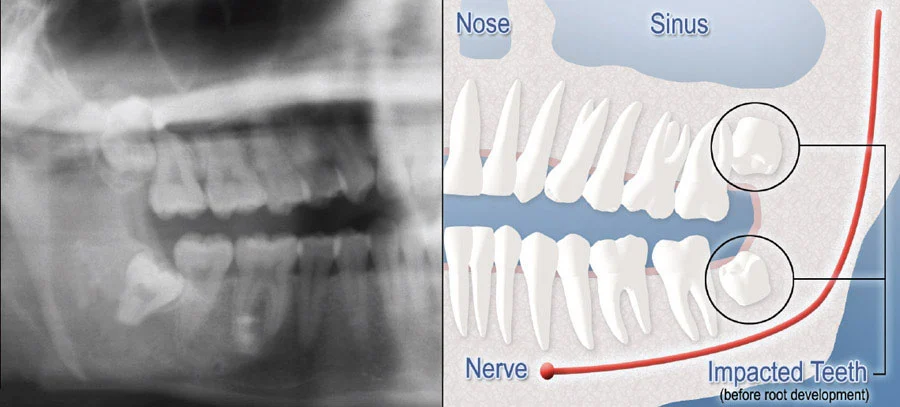
Although most people develop and grow 32 permanent adult teeth, many times your jaw is too small to accommodate the four wisdom teeth. When inadequate space prevents your teeth from erupting, they are called impacted wisdom teeth. This indicates their inability to erupt into the proper position for chewing and cleaning.
Determining Your Treatment Plan
You’ll need a consultation to determine if you will benefit from wisdom tooth removal. A special x-ray of your mouth and jaws (panorex) will be taken to determine if your wisdom teeth are impacted, if there is room for them to erupt, and how difficult it will be to have them removed.
At Northwest Oral Surgeons, our advanced 3D imaging technology provides precise visualization of your wisdom teeth position, allowing Drs. Wolf, Mekhail and Moll to plan your procedure with accuracy and predict any potential complications before surgery.
Types of Impactions
Understanding the type of impaction you have helps determine the complexity of your procedure and recovery time:
Soft Tissue Impaction
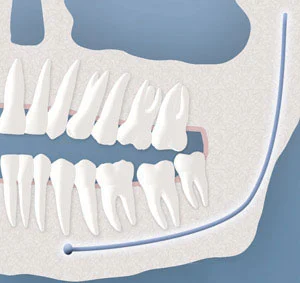
There is not enough room to allow the gum tissue to retract for adequate cleaning of your tooth. While the tooth may have erupted through the bone, the surrounding gum tissue covers part or all of the crown, making it impossible for you to keep the area clean. This can lead to infection and decay.
Partial Bony Impaction

There is enough space to allow your wisdom tooth to partially erupt. However, the tooth cannot function properly in the chewing process and creates cleaning problems, among others. The tooth is partially stuck in the jaw bone, leaving you vulnerable to infection, decay, and damage to adjacent teeth.
Complete Bony Impaction

There is NO space for your tooth to erupt. It remains completely embedded in your jaw bone or, if even partially visible, requires complex surgical techniques for removal. Your impacted wisdom tooth may also be in an unusual position and difficult to remove. This situation can also arise when the shape or size of your jaw bone and other facial structures make removal of this tooth significantly more complex.
Why Your Impaction Type Matters
The type of impaction affects several aspects of your treatment:
- Surgical complexity: Soft tissue impactions are typically simpler to remove, while complete bony impactions require more extensive surgical techniques
- Recovery time: More complex impactions may require longer healing periods
- Risk factors: Different impaction types carry varying risks for complications
- Timing: Some impactions require immediate attention, while others can be monitored
Signs You May Have Impacted Wisdom Teeth
You might experience:
- Pain or tenderness in the back of your mouth
- Swelling around the jaw
- Difficulty opening your mouth
- Bad breath or an unpleasant taste
- Occasional difficulty swallowing
- Swollen, tender, or bleeding gums
Even if you’re not experiencing symptoms, impacted wisdom teeth can cause hidden problems, including damage to neighboring teeth, cyst formation, and bone loss.
The Importance of Early Evaluation
Early evaluation and treatment of impacted wisdom teeth, typically in the mid-teenage years, result in a superior outcome for you. At this age:
- Your tooth roots are not fully developed
- Your bone is less dense, making extraction easier
- You heal faster with fewer complications
- You can avoid future problems before they develop
Your Next Step
Don’t wait for pain or complications to develop. At Northwest Oral Surgeons in Schererville, IN, our specialists have extensive experience with all types of wisdom tooth impactions. Using state-of-the-art technology and techniques, we make even complex extractions as comfortable as possible.